The Strategic Blueprint for Premium Villa Procurement: Sourcing Value Across the Florida Gulf Coast
The vacation rental market along the Florida Gulf Coast has transitioned from rustic beach shacks into a highly sophisticated inventory of independent upscale homes. Driven by multi-generational families and travel groups prioritizing space, privacy, and dedicated amenities, the region features a dense layout of high-end villas. Unlike uniform luxury hotels, the private villa ecosystem operates under a distinct set of operational, logistics, and financial frameworks. Managing these variables systematically is required to capture premium residential features without incurring excessive costs.
Securing high-tier accommodations along the Gulf of Mexico requires a professional approach to inventory searching, seasonal timing, dynamic pricing algorithms, and property verification. Finding affordable luxury villa rentals in florida gulf coast is the result of structured financial planning, geographic arbitrage, and an understanding of the local vacation rental management pipeline. This guide establishes an objective, textbook-quality framework detailing the core mechanics of selecting, budgeting for, and managing a premium villa stay.
Overview of Gulf Coast Premium Villa Procurement
Sourcing affordable luxury villa rentals in florida gulf coast requires analyzing how independent premium homes are managed, distributed, and priced. The Florida Gulf Coast stretches from the emerald waters of the Northwest Panhandle down to the tropical barrier islands of Southwest Florida. Across this expanse, “luxury” in the villa market is defined by specific physical assets: private heated pools, expansive water frontage (ocean, bay, or canal), high-end kitchen arrays, professional interior architecture, and dedicated outdoor living zones.
Travelers commonly utilize these private residential configurations to bypass the high density and restrictive space constraints of traditional beachfront hotels. The objective is to secure a property where group assembly spaces exist alongside private en-suite bedrooms. Capturing these features affordably requires travelers to identify market inefficiencies, negotiate directly with localized management companies, utilize seasonal compression windows, and leverage neighborhood configurations that sit just behind the high-cost primary beach strip. By applying a rigorous evaluation framework, travelers can secure upscale property standards while maintaining predictable limits on out-of-pocket capital.
Primary Property Architectural Typologies
The rental inventory along the Gulf Coast is shaped by local building codes, coastal topography, and historical development trends. Understanding these typologies allows travelers to select a property layout aligned with their specific party demographics.
Structural Typology Matrix
| Category / Type | Description | Common Use Case | Time / Cost / Effort Level |
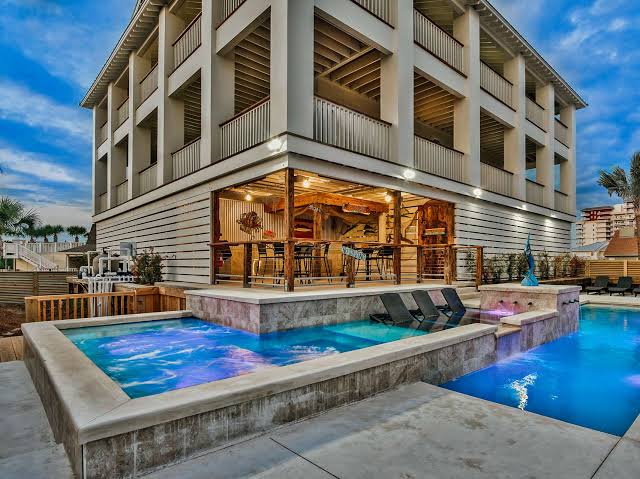
| Barrier Island Stilt Homes | Multi-level properties built on wood or concrete pilings to meet storm-surge requirements, featuring open lower-level parking decks and panoramic balconies. | Beachfront or near-beach stays on islands; ideal for groups prioritizing immediate ocean views and direct sand access. | High Search Time / High Base Cost / Moderate Effort |
| Canal-Front Coastal Ranches | Single-story, expansive mid-century or modern ranch designs featuring private boat docks, screened pool cages (lanais), and deep water access lanes. | Extended family stays with young children or elderly relatives requiring step-free, single-level living profiles. | Low Search Time / Medium-High Cost / Low Daily Effort |
| New Urbanist Townhomes | Vertically integrated, multi-story masonry structures situated within high-density, pedestrian-only planned communities. | Travel parties prioritizing walkability to neighborhood shopping, dining corridors, and town squares over complete isolation. | Moderate Search Time / High Base Cost / Low Planning Effort |
| Inland Estate Mansions | Large-acreage properties situated 1 to 5 miles behind the coast, featuring expansive footprints, private sports courts, and detached guest houses. | Multi-family reunions or corporate retreats requiring maximum bedroom counts and high privacy thresholds at lower per-square-foot rates. | Moderate Search Time / Medium Cost / High Logistics Effort |
Selecting the Proper Structural Format
Choosing among these architectural layouts depends heavily on your party’s mobility constraints and trip priorities. Multi-level stilt homes maximize wind and water vistas but require constant stair navigation, which can present accessibility challenges for elderly guests or families with toddlers. Single-story canal-front ranches offer consistent step-free configurations and include screened pool cages that keep out local insects, making them highly functional for young families. New Urbanist townhomes trade private acreage for walkable urban infrastructure, reducing the need for continuous car travel.
Practical Scenarios and Geographic Applications
Reviewing specific regional applications across the Florida Gulf Coast highlights how to identify properties that optimize the relationship between luxury asset tiers and out-of-pocket costs.
Scenario 1: The Barrier Island Multi-Family Stay
Two families coordinate a shared vacation on a premium barrier island, requiring four distinct bedrooms, a private pool, and walking access to the beach, while managing the total room tariff.
-
Step-by-Step Procurement Process:
-
Map out target barrier islands known for low-density residential zoning and independent rental structures.
-
Screen for properties located in the “second-tier” block—properties situated 1 to 2 streets back from the direct gulf-front sand line.
-
Verify via local property tax maps that the villa includes a dedicated, legally recorded public beach easement path to avoid walking around private parcels.
-
Select a multi-level stilt configuration where kids’ bunk rooms are situated on a separate floor from the primary adult suites.
-
-
Key Components: Second-tier block placement, deeded beach access easements, separate multi-level bedroom zones, private pool facilities.
-
Representative Geography: Anna Maria Island, Siesta Key, or Longboat Key.
Relevance of the Barrier Island Scenario
Direct beachfront placement carries a massive real estate premium, often doubling the nightly rate. By shifting the search grid exactly one block inland into the second-tier residential row, families can capture identical internal square footage, private pools, and high-end finishes at a substantial discount, while retaining brief 3-minute walking paths to the sand.
Scenario 2: The Deep-Water Canal Single-Level Stay
A travel group containing three generations requires a step-free, single-story layout with water visibility, a private heated pool, and deep-water boating access for local fishing excursions.
-
Step-by-Step Procurement Process:
-
Target coastal communities built around extensive network canal systems featuring immediate access to bays or the open Gulf.
-
Filter explicitly for single-story ranch architectures, eliminating properties that require climbing structural stairs to access the main living space.
-
Confirm that the pool deck area is fully enclosed within a screened lanai structure to prevent insect entry during evening hours.
-
Ensure the private boat dock incorporates an operational boat lift or adequate mooring cleat configurations matching local tidal shifts.
-
-
Key Components: Single-level concrete construction, screened lanai enclosures, private boat dock access, proximity to open water passes.
-
Representative Geography: Cape Coral, Punta Gorda Isles, or Marco Island canal corridors.
Relevance of the Canal Scenario
Canal-front networks offer extensive waterfront real estate options behind the primary oceanfront. This infrastructure allows families to secure large, single-story upscale homes with direct private water access and boat docking capabilities at manageable price thresholds, which is especially helpful for multi-generational groups with limited mobility.
Scenario 3: The Panhandle Coastal Planned Village Stay
A travel party seeks an upscale townhome or cottage layout situated within a design-focused, pedestrian-friendly village, looking for walkability and neighborhood infrastructure.
-
Step-by-Step Procurement Process:
-
Identify planned master communities along the northwest scenic highway corridors that utilize New Urbanist design rules.
-
Filter for vertically integrated townhomes or cottages that feature private courtyards or rooftop terraces rather than large lawns.
-
Verify that the property includes a complimentary neighborhood low-speed vehicle (LSV) or street-legal golf cart to access community beach entry points.
-
Confirm that the rental package grants full access rights to centralized community amenities, including fitness centers, lap pools, and private beach pavilions.
-
-
Key Components: Vertically integrated masonry builds, neighborhood golf cart inclusions, community facility access rights, walkable pedestrian plazas.
-
Representative Geography: The 30A corridor, including Rosemary Beach, Seaside, or Miramar Beach perimeters.
Relevance of the Planned Village Scenario
Planned communities offer an integrated lifestyle where dining, retail, and beach lanes connect via pedestrian footpaths. Sourcing a townhome configuration within these architectural zones allows groups to minimize vehicle usage completely, utilizing community parks and fitness infrastructures that function as a seamless extension of the villa footprint.
Scenario Comparison
The Barrier Island scenario prioritizes immediate proximity to the gulf sand via second-tier block optimization. The Canal scenario focuses on single-story accessibility and boating infrastructure along internal waterways. The Planned Village scenario centers on high-density architectural design and neighborhood walkability. Travel groups with toddlers or mobility challenges benefit most from the single-level Canal configuration, while groups with teenagers or active adults typically prefer the autonomy and social density of the Planned Village framework.
Planning, Budgeting, and Ancillary Fee Matrix

The rental of an independent luxury villa involves unique operational expenses that do not occur in conventional hotel environments. To achieve absolute value, a budget must account for municipal hospitality taxes, cleaning overhead, utility surcharges, and security deposits.
Sample Villa Procurement Budget & Resource Framework
Note: The values, ratios, and fees outlined below represent illustrative examples for an upscale four-bedroom, three-bathroom private pool villa stay over six nights and will fluctuate based on seasonal demand curves, precise geographic location, and local economic conditions.
| Category | Estimated Allocation | Explanation | Optimization Tips |
| Base Villa Rental Rate | $350 – $800 / night | The baseline cost for a premium independent home featuring high-end finishes and a private pool. | Schedule arrivals during the shoulder season (e.g., May after Easter or October–November before Thanksgiving) to capture up to 40% rate reductions. |
| Florida State & Local Resort Taxes | 11% – 13% of base rate | Combined Florida state sales tax plus county-level tourist development taxes. | Factor this mandatory legislative overhead into your primary budget baseline before executing contract confirmations. |
| Departure Cleaning Fee | $250 – $450 / stay | A fixed flat charge applied by professional management companies to return the home to pristine standards post-stay. | Look for longer booking windows (e.g., 7+ nights) where the impact of this fixed flat fee is absorbed across more days. |
| Pool Heating Utility Surcharge | $30 – $60 / day | The energy cost required to operate automated heat pumps or gas heaters to maintain pool temperatures at 85°F (29°C). | Inquire about pool orientation; south-facing pools capture natural solar heat throughout the day, minimizing mechanical heating runtime. |
| Accidental Damage Waiver Fee | $45 – $85 / stay | A non-refundable insurance premium that replaces a large traditional refundable security cash deposit. | Opt for properties utilizing verified commercial damage waivers to avoid locking up thousands of dollars in cash balances during transit. |
Sourcing Strategies and Verification Channels
Identifying legitimate affordable luxury villa rentals in florida gulf coast requires moving past conventional, high-fee global aggregator portals toward localized procurement strategies.
1. Localized Vacation Rental Management Companies (VRMs)
-
What it is: Sourcing homes directly through established, brick-and-mortar property management firms based inside the target municipality.
-
Advantages: Bypasses the 5% to 15% traveler service fees charged by global online travel agencies (OTAs); ensures uniform standards for cleanliness, local maintenance response, and on-call guest support.
-
Disadvantages: Search results are restricted exclusively to the specific inventory managed by that singular firm.
2. Verified Regional “By Owner” Listings Platforms
-
What it is: Utilizing state-specific or regional listing marketplaces that connect consumers directly with verified homeowners without intermediate platform commissions.
-
Advantages: Lower transaction overhead; allows direct communication with the property owner to confirm layout nuances, equipment lists, and flexible check-in options.
-
Disadvantages: Requires manual verification of ownership identity via local county property appraiser databases to avoid fraud risks.
3. MasterPlanned Community On-Site Rental Programs
-
What it is: Booking via the centralized, official rental management office operated by the developer or home-owner association of a specific resort community.
-
Advantages: Guarantees absolute compliance with community rules; ensures seamless, un-restricted access keys to neighborhood beach clubs, fitness centers, and tennis courts.
-
Disadvantages: Base rates are typically more rigid and less open to individual consumer negotiation compared to unaligned private homes.
4. Premium Hotel Co-Branded Home Collections
-
What it is: Reserving independent private homes that have been vetted and placed under the management banner of international luxury hospitality brands.
-
Advantages: Allows integration with global hotel loyalty points programs; ensures properties adhere to strict brand guidelines regarding bedding, toiletries, and high-speed tech infrastructure.
-
Disadvantages: Carries a structural brand premium fee that can push base pricing into higher brackets regardless of the season.
Operational Risks, Pitfalls, and Mitigation Advice
Managing private residential rentals introduces specific vulnerabilities that do not exist within standardized hotel towers. Travelers must actively mitigate these four primary operational risks.
Construction Intrusion and Local Zoning Shifts
-
The Issue: The Florida Gulf Coast undergoes continuous residential development and coastal remodeling. Arriving guests can find their premium pool deck situated directly adjacent to an active, loud multi-story home construction site.
-
Prevention Advice: Prior to finalizing a rental contract, input the property’s exact physical address into the local city or county municipal building department permit portal. Check for active, approved construction or remodeling permits within a two-parcel radius of your target home.
Pool Heating Failures and Temperature Mismatches
-
The Issue: During winter months (December through February), ambient night temperatures along the Gulf can drop significantly. Standard electric pool heat pumps cannot effectively warm water if ambient temperatures fall below 50°F (10°C), resulting in cold pools despite paying heating fees.
-
Prevention Advice: Verify the type of pool heater installed. If traveling during the coldest winter weeks, prioritize properties that utilize gas or propane pool heaters, which function independently of external ambient air temperatures.
Stringent Local Noise and Occupancy Ordinances
-
The Issue: Many Gulf Coast beach municipalities enforce strict vacation rental ordinances. These laws mandate quiet hours starting at 10:00 PM, restrict outdoor pool use at night, and impose strict parking vehicle limits that can trigger heavy municipal fines or immediate eviction if violated.
-
Prevention Advice: Review the property’s explicit neighborhood rules before booking. Ensure your travel party size and vehicle count comply with the home’s legally allowed occupancy limits, and remind all guests to move indoors by the designated evening ordnance times.
Property Condition and Marketing Inaccuracies
-
The Issue: Vacation rental photos can remain online for years without updates. A villa marketed as a pristine luxury space may exhibit significant wear, weathered patio furniture, or old kitchen appliances due to high guest turnover and harsh coastal salt air.
-
Prevention Advice: Filter guest review logs strictly by the “Most Recent” setting. If no verified reviews have been logged within the past 90 days, request that the management company share recent smartphone photos or a live video walkthrough of the main living spaces and pool deck before signing the lease.
Best Practices for Check-In and Property Verification
Executing a systematic review workflow immediately upon arrival protects your financial security and ensures structural compliance.
The On-Site Arrival Assessment Protocol
-
Immediate Exterior Structural Walkthrough: Inspect the pool enclosure cage (lanai) for tears in the mesh screens, test the safety locks on the pool perimeter gates, and confirm that the outdoor grill possesses adequate fuel resources.
-
Internal Mechanical and Utility Verification: Run all HVAC climate control systems to ensure cold air distribution is functional across all bedrooms, check the water pressure in all showers, and verify that the en-suite refrigerator reaches proper food safety temperatures within three hours.
-
Document Baseline Discrepancies: Utilize a smartphone camera to capture high-definition video of any pre-existing wall marks, worn furniture, stained textiles, or mechanical issues. Email these timestamped files to the property manager within the first four hours of check-in to establish that the issues existed prior to your stay.
The Value of Immediate Reporting
Waiting until the conclusion of your stay to report mechanical or structural failures undermines your credibility and prevents the local management company from executing necessary repairs. Immediate notification allows maintenance teams to resolve utility issues during daylight hours, preserving the comfort and quality of your vacation.
Documentation, Audit Logs, and Group Organization
To manage a multi-family villa stay smoothly, travelers should centralize all property data, emergency routing information, and financial records into a unified master document.
Tips for Managing Residential Property Data
-
Digitize Local Access Codes: Store all smart-lock entry pins, gate security codes, and local Wi-Fi passwords in an offline-accessible digital note shared with all adult members of the party.
-
Centralize Emergency Utility Locations: Locate and document the physical positions of the main water shut-off valve, the outdoor electrical breaker box, and the automated pool equipment panel upon arrival.
-
Map Essential Medical Links: Note the contact numbers, operational hours, and driving paths to the closest 24-hour emergency hospital and urgent care clinic relative to the villa’s physical address.
Illustrative Property Integration Logs
Example 1: Barrier Island Stilt Villa Log
-
Property Parameters: Villa 104, Anna Maria Island. Structure: 3-Story Stilt Home. Entry Code: 4920#. Deeded Beach Access: Footpath directly across Gulf Drive via Easement Marker 7. Parking Capacity: 3 Vehicles max inside lower bay. Noise Ordnance: Strict 10:00 PM outdoor curfew enforced by municipal code.
Example 2: Canal-Front Single-Level Ranch Log
-
Property Parameters: The Pelican Retreat, Cape Coral Canals. Structure: Single-Story Ranch with Screened Lanai. Pool Heater: Gas fired (activated via panel inside kitchen pantry). Dock Parameters: 30-foot private wood dock, deep-water canal leading to Caloosahatchee River. Emergency Node: Regional Medical Center located 8.4 miles East.
Closing Summary
Sourcing affordable luxury villa rentals in florida gulf coast requires moving away from emotional booking habits and toward calculated procurement strategies. By targeting second-tier neighborhood grids just behind the oceanfront, focusing on single-story canal networks for step-free accessibility, bypassing global platform fees via localized property management firms, and executing rigorous room assessments upon arrival, travelers can consistently capture five-star residential space and amenities at manageable price points. While this systematic approach requires more detailed research, municipal code checks, and proactive communication with local operators, the result is a highly optimized, safe, and memorable Gulf Coast vacation tailored perfectly to the needs of the entire group.
Frequently Asked Questions (FAQ)
What defines a vacation rental as a verified “luxury villa” along the Florida Gulf Coast?
A verified luxury villa along the Florida Gulf Coast is characterized by an upscale independent residential build featuring a private heated pool, an expansive outdoor living area (often within a screened lanai), a high-end chef’s kitchen, high-quality interior finishes, multiple en-suite bedrooms, and premium geographic placement—such as direct gulf access, canal frontage, or close proximity to a beach entry point.
Why do identical villas feature lower rates when located one block behind the beach?
Direct beachfront real estate carries a massive premium driven by limited land inventory and open gulf views. Properties located exactly one or two streets back—known as second-tier or interior-row properties—avoid this direct land premium. Shifting your search grid into this zone allows you to secure identical square footage, high-end amenities, and private pools at a substantially lower cost, while retaining brief 3-minute walking paths to the water.
What is a screened “lanai” and why is it important for Florida rentals?
A lanai or pool cage is an architectural patio enclosure consisting of a high-clearance aluminum frame wrapped in fine micro-mesh screening. This structure completely encloses the pool deck and outdoor living spaces. It is highly valued along the Gulf Coast because it allows families to utilize the pool and outdoor dining areas during evening hours without disruption from local insects, while still allowing full sunlight and sea breezes to pass through.
Are pool heating fees mandatory, and should I pay for them?
Pool heating fees are typically managed as an optional daily utility surcharge ranging from $30 to $60 per day. Paying for pool heating is strongly recommended if you are traveling between October and April. Even during sunny winter days, ambient night temperatures along the Gulf drop low enough to cool unheated pools into uncomfortable ranges, making a mechanical heater necessary to maintain a comfortable swimming temperature.
How can I verify that a direct “by owner” villa listing is not fraudulent?
To protect your reservation security, copy the physical address of the property from the listing and cross-reference it within the official online public property appraiser database maintained by the county government where the home resides (e.g., Sarasota or Lee County Appraiser Portal). Verify that the deeded owner’s name matches the identity of the individual or management firm executing your rental lease agreement before sending any financial deposits.